HOW TRAKTO HELPS IN
Plastic factories run on guesswork.
Compound to cured part : costing, stock, purchase and delivery dates on one system.
Jump to explore a feature
ONE SYSTEM. EVERYTHING CHANGES.
03. THE FOUR BENEFITS
Stop calculating costs by hand
Trakto gives you cost per piece in seconds: at today’s material prices, the latest formulation for the compound, with this month’s overheads already in it.
Ten minutes of costing becomes ten seconds.
Order material by days, not guesses
You don’t order by kilograms. You order by “until when will this last”. Trakto tells you how many days each material has left at the rate you’re actually consuming it.
No line stoppages. No godown full of dead polymer.
Promise dates you can keep
Customer asks when. Right now that’s a ten-second guess he’ll hold you to for a month. Trakto works it out from real planning and scheduling, with a simple reordering interface.
Give the date. Hit the date.
Stop the leakage
100 pcs out should consume a known quantity of compound in kg and its raw materials. When it doesn’t, you find out during dispatch, loss already incurred. Trakto flags it the same day, on that batch.
Process loss becomes a number with a name on it.
PRODUCTION + INVENTORY
Results
Time Saved
Up to 120 hrs/month recovered across office and store
Customer Promises Held
Committed Dates and timeline from true capacity
Margins Saved
Rates move, cost moves everyday.
WHAT MAKES TRAKTO DIFFERENT
Every generic ERP can run a factory. Here’s where they stop working in a rubber plant.
GENERIC ERP
TRAKTO
One bill of materials per finished good. Forty parts, forty BOMs.
One compound, forty parts, one recipe to maintain.
Reorder when stock hits a quantity someone typed in once.
Reorder when a material has 12 days left.
Overheads as a flat percentage on top.
Overheads absorbed by logging factory expenses
Someone in the office enters yesterday’s production.
The operator who ran the batch enters it, on his phone.
Everything below is one of those differences, in detail.
ORDER TO PROFIT
1
Sales Order
→
2
Purchase
→
4
Production
→
5
Dispatch
→
✓
True Profit
Sales Order
Create the customer order with products, quantities, and prices and any other custom details required.
Demand captured
Purchase Order
Turn confirmed demand into purchase orders for raw material. Approve it, Email it to vendors.
Materials on the way
Goods In
When material arrives, record the receipt and update stock instantly or hold it for approval. Batch, cost, and availability stay visible for the teams that need them.
Stock available
Work Orders
Plan production work directly against the sales order. Track progress, issue material, and keep the shop floor aligned with demand.
Production planned
Production Entry
Capture output as work progresses. Track scrap, rejections, SFG, and finished goods. Consume Materials automatically if store department doesn't exist.
Finished goods ready
Dispatch
Dispatch the right batch with FIFO picking. Actual material cost, shipment status, and stock levels update as the order leaves.
Orders fulfilled
Margin & Insights
See what each order actually earned—not just the quoted estimate. Materials, labour, overheads, and production details combine into live margin insight.
True profit visible
Log production once
one entry
Raw Material Deducts
Inventory updates
Purchase alerts
Real cost appears


Materials deducted at exact recipe weights, batch by batch
No store department needed to keep stock live
Manual issue-against-work-order stays available if you want the control
COSTING INTELLIGENCE
Accurate Costing with Overheads
Trakto takes your recorded monthly expenses and absorbs them onto parts on a real basis so what you see is a full cost per piece, not material plus a guess.
Power, labour, wood, mould amortisation and rent recorded monthly, once
Absorbed onto parts by actual basis, not a flat percentage across everything
The number you quote from is the full cost, material and conversion together

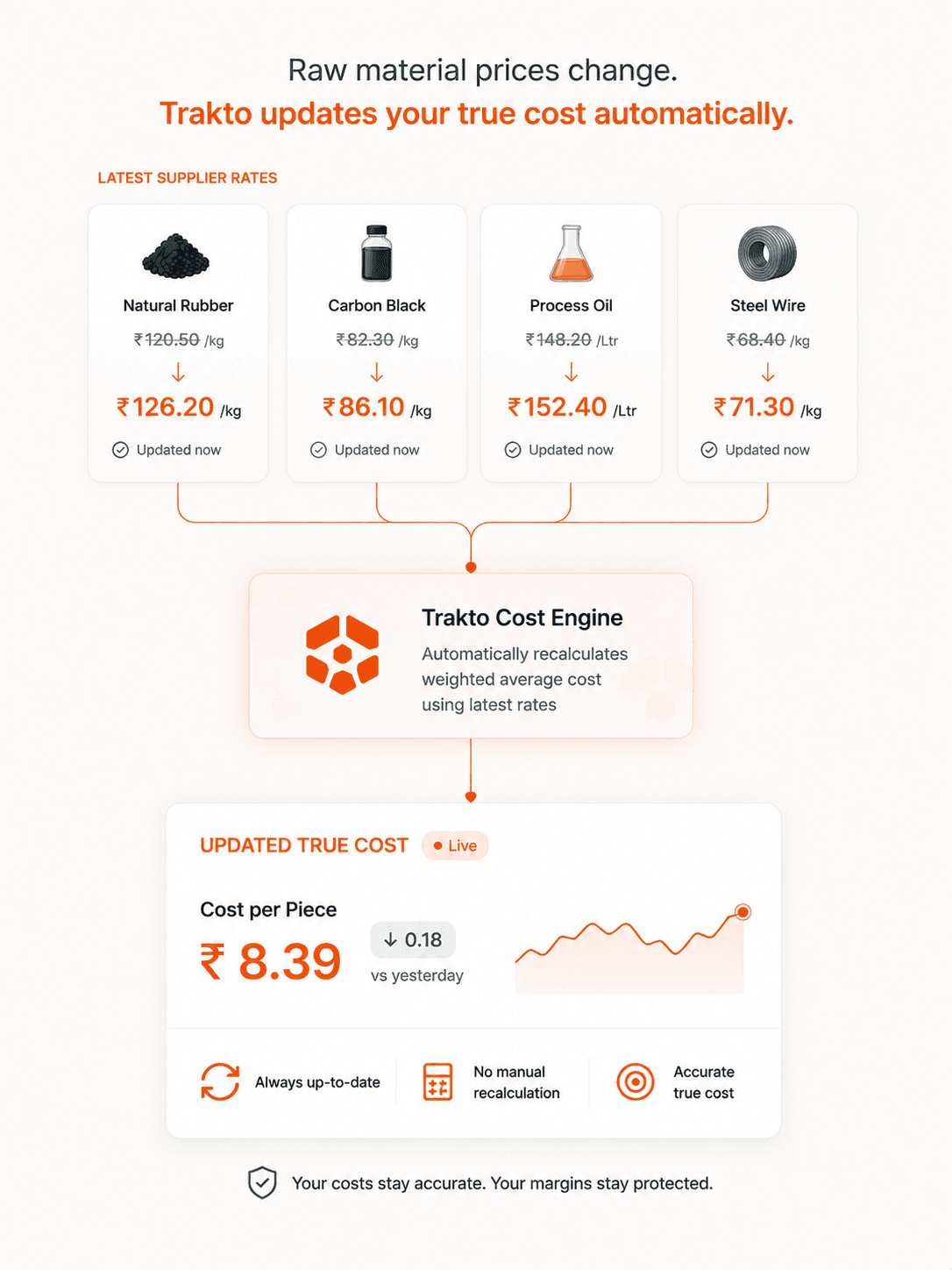
Cost auto calculates with live rates, every formula
Trakto rebuilds cost per piece every time an input changes: piece weight, the recipe at today's prices, and this month's recorded overheads. Open a part and you see what it costs you today, not what it cost the day you developed it.
Rates update from your own purchase entries — no separate rate master
Formula change re-costs every part using that compound, instantly
Cost built from the actual recipe and piece weight, not a rounded per-kg rate
See what a part cost you last month against what it costs today


STOP MATERIAL LEAKAGES
Stop Material Loss and Leakages
A 100 kg batch, a known piece weight and a known count should give you raw material quantity that matches. Trakto compares actuals against estimated on every single work order to give you reports on excess consumption and loss.
Estimated vs actual consumption on every batch
Rejections logged by reason, at the stage they happened
Re-learns as your product mix changes — nobody maintains reorder levels
Requirements pulled from confirmed sales orders, not last month's average
NO COMPUTER OPERATOR REQUIRED
Trakto · Production
WO-248 · Mixing batch
Press 03 · 1,240 pieces
Book production
What your operator does on his phone
Book production — pick the work order, enter pieces, done.
Change the formula — one tap before the batch, so the right materials get consumed.
Log rejections — by reason, at the stage it actually happened.
Issue and receive material — weight in, weight out, against the batch.
No terminal on the floor. No register. No paper walking to the office at 6 pm.
Trakto · Today
Production vs plan
18,420 / 21,000 pcs · Live
See live report
What you see on yours
Today’s production against plan, live.
Stock and days left on every material.
Pending orders and where each one has reached.
Margin by customer and by dispatch.
From the car, from a customer’s office, from anywhere that isn’t your factory.
No computer operator or data entry person to hire: that’s a salary you don’t add.
Runs on the ordinary Android phone your operator already carries.
Entries are live the moment the batch closes, not the next morning.
Supervisor can approve or correct an entry from his own phone.
Low data usage — works on a weak factory connection.
Owner app is separate: reports and numbers, no data entry.
RUNWAY DAYS
Set your reorder alert in days. Not kilograms.
Rubber is continuous consumption. The mixer runs all day and every batch pulls the same ten materials by weight, so stock drains steadily instead of in visible chunks.
Trakto learns how much you actually consume on average and turns that stock into days. You set the alert in days left, and it keeps itself correct as your mix changes.

Reorder alerts on days left, not a fixed minimum quantity
Runway calculated from your real consumption, not a level someone typed in once
Re-learns as your product mix changes — nobody maintains reorder levels
Requirements pulled from confirmed sales orders, not last month's average
SMART RESCHEDULING
Drag. Drop. Reschedule Orders.
Give a date you can keep.
Automatically Estimates when the order will be ready based on actual production pace historically and as per work order. When you reorder, everything updates automatically. Logging actual production, holidays will automatically push the estimates.

Schedule Orders Per Machine
Schedule Per Machine Moulds
Always be on track with Customer
Sales Intelligence
Know where your margin comes from.
Every sales order carries its origin, its customer, its margin, and its dispatch cost — so you see where money comes from and where it leaks.
Year-end profit tells you the factory worked. It doesn't tell you that your second-largest customer - hardest negotiator, smallest lots, wants his own packing — is running at 4% while a quiet account elsewhere runs at 26%. Averages hide the exact thing you'd act on.
Profit % per customer, per region, per part
Variance against the margin you set at quotation
Per-dispatch profit — one bad lot can't hide inside a good month
Know which price revision to ask for first

7. OBJECTIONS
Four things you’re thinking right now.
“We already run Tally.”
“My operators won’t use software.”
“We tried an ERP once. It died.”
“Our process isn’t standard.”
READY TO RUN A TIGHTER FACTORY